Your Cart is Empty


Rodrigo Sánchez Passionfruit Co-ferment
Guava, blood orange, blackberry and honey
Past offering
This coffee is no longer on our menu.
Brew companion
Brew this coffee
Choose your method and we’ll guide the timing, one step at a time.
Expression
Tasting Notes
Guava, blood orange, blackberry and honey
Acidity
Mellow Bright
Sweetness
Subtle Pronounced
Body
Light Full
Origin
Country
Colombia
Region
Huila
Producer
Rodrigo Sánchez Valencia
Farm
Finca Monteblanco
Craft
Variety
Purple Caturra
Process
Passionfruit Co-Fermented Washed
Fermentation
150-hour anaerobic co-fermentation with passionfruit culture in sealed tanks
Elevation
1730 meters
Roast Level
Lighter Darker
Expression
Origin
Craft
Tasting Notes
Guava, blood orange, blackberry and honey
Acidity
Mellow Bright
Sweetness
Subtle Pronounced
Body
Light Full
Country
Colombia
Region
Huila
Producer
Rodrigo Sánchez Valencia
Farm
Finca Monteblanco
Variety
Purple Caturra
Process
Passionfruit Co-Fermented Washed
Fermentation
150-hour anaerobic co-fermentation with passionfruit culture in sealed tanks
Elevation
1730 meters
Roast Level
Lighter Darker


What does passion fruit co-fermented coffee taste like?
The guava hits the moment you grind - pink-fleshy sweetness layered with blood orange brightness and something darker underneath. That tropical character persists and evolves as your cup cools. Blackberry and honey anchor the finish, giving the tropical notes somewhere to land.
This coffee’s playful, complex flavor profile comes from a 340-hour fermentation protocol applied to Purple Caturra, a mutation that appeared in just 26 trees out of 25,000 planted in Colombia's Huila region in the 1980s.


How Rodrigo Sánchez controls the anaerobic fermentation process
Those purple-ripening cherries measure 20-23 degrees Brix - think of sugar content like grape ripeness in winemaking. Higher Brix means more fuel for fermentation microbes. Rodrigo pre-ferments a mother culture for 190 hours with 10 yeast strains, lactic acid bacteria, and fresh passion fruit, calibrating it to match the coffee's own chemistry before 150 more hours in sealed tanks below 25°C.
Co-fermented coffees are a polarizing topic. Competition circuits that ban fruit co-fermentation as "adulteration" miss the point - when pH holds above 4.0 and temperature stays controlled, compounds migrate into the bean through diffusion, not addition. We pay a premium for these unique coffees as a vote of confidence in this kind of innovation and experimentation.


Purple caturra with intense juicy sweetness.
V60 and Chemex give you bright tropical fruit with clean finish - pull your water off before boiling (around 200°F) and grind slightly coarser than usual. AeroPress shifts the balance toward body and integrated sweetness where the honey note steps forward.
We roast every Monday and Thursday - try the 8oz sample before committing if you're uncertain about the profile. Every batch tastes slightly different even with identical roasting and brewing protocols, fermentation being fermentation.
Brewing Guides
Brew Rodrigo Sánchez Passionfruit Co-ferment like we do - here’s how.
Highlights clarity and acidity; best with precise grind, flow control, and flat or conical brewers.
| Brew Ratio | 1:16 (e.g., 20g coffee to 320g water) |
| Grind | Medium (like table salt) |
| Water Temp | 92°C / 198°F |
| Total Brew Time | 2:45 – 3:15 min |
| Yield | 300–320g |
Brew slightly cooler to preserve fermentation aromatics. A slow, centered pour highlights passion fruit vibrancy and tropical complexity without overwhelming acidity.
Full immersion with coarse grind; great for body, sweetness, and lower-acidity profiles.
| Brew Ratio | 1:15 (e.g., 30g coffee to 450g water) |
| Grind | Coarse (like sea salt) |
| Water Temp | 92°C / 198°F |
| Total Brew Time | 4:30 – 5:00 min |
| Yield | 400–450g |
Gentle agitation mid-steep opens layered tropical notes. The full immersion rounds fermentation brightness into a syrupy, fruit-forward cup.
Pressure extraction with fine grind; isolates intensity, structure, and balance.
| Brew Ratio | 1:2.5 (e.g., 18g coffee to 45g espresso) |
| Grind | Fine (like powdered sugar) |
| Water Temp | 92°C / 198°F |
| Total Brew Time | 28 – 32 sec |
| Yield | 40–45g |
Pull longer to balance intense fruit character with body. Showcases passion fruit and tropical esters with a wine-like finish from the extended fermentation.
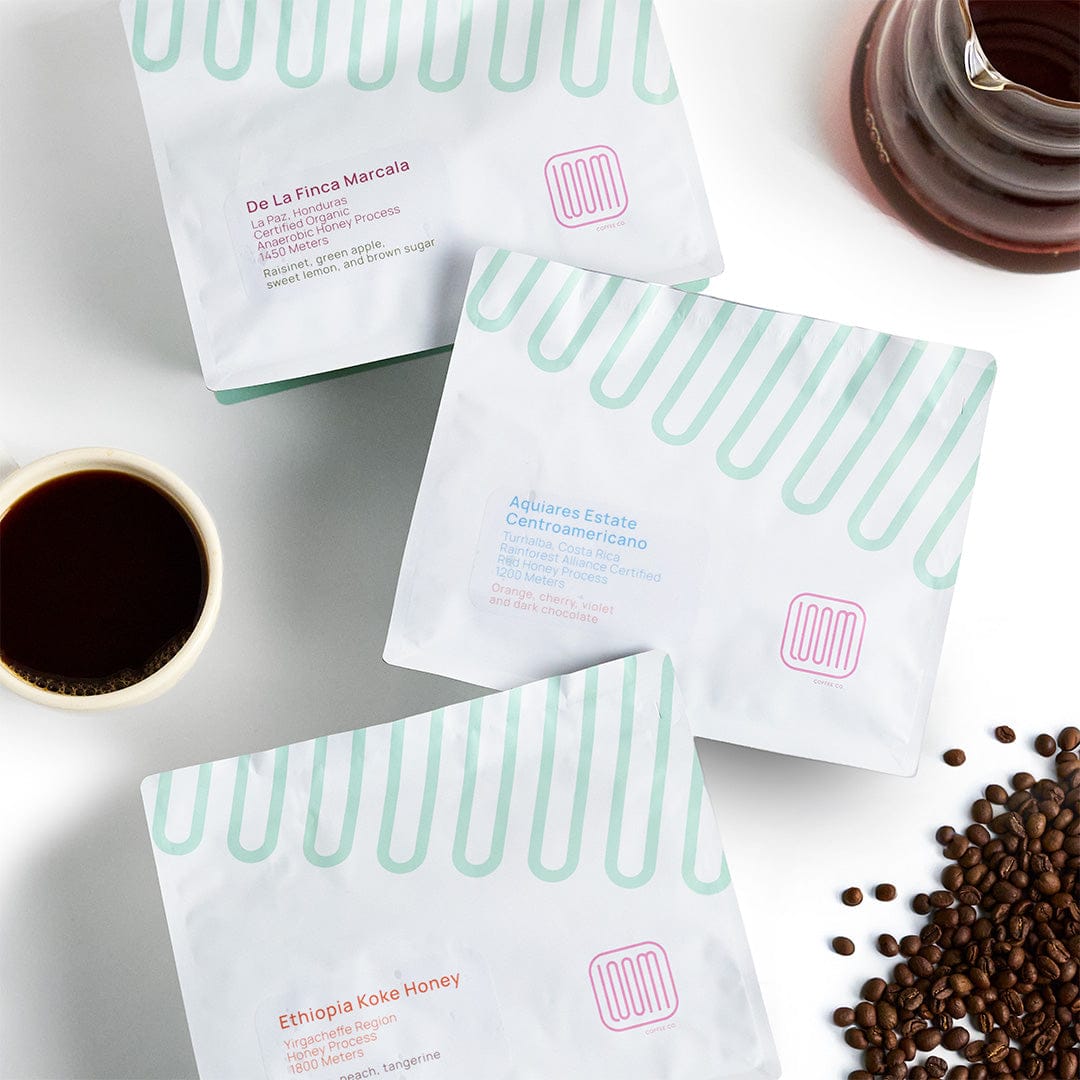

Try coffees like this one, on your schedule.
The Rotation is your coffee membership. Every order is a different single-origin, roasted to order and shipped within 48 hours. Explore our full lineup and find you next favorite.
You set the schedule, adjust or cancel anytime.
Co-fermentation introduces a secondary biological culture, usually fruit, yeast, or bacterial starters, into the fermentation environment alongside coffee cherry. The compounds integrate through diffusion: the fruit culture shapes the fermentation chemistry, and the coffee absorbs those compounds through its permeable seed structure. The result is a cup that reflects both the coffee's origin character and the chemistry of the co-ferment agent.
Purple Caturra is a rare genetic mutation of the Caturra variety first observed in Huila, Colombia. Only 26 trees out of 25,000 planted Caturra exhibited the purple phenotype. Its scarcity makes it one of the most limited varieties in specialty coffee. Rodrigo Sánchez has cultivated it at Finca Monteblanco specifically for experimental processing.
Anaerobic fermentation seals coffee in oxygen-deprived tanks, which shifts microbial activity toward lactic acid bacteria that thrive without oxygen. These bacteria produce different organic acids and aromatic compounds than the aerobic bacteria in open-air fermentation. The 340-hour total protocol here involves a 190-hour pre-fermentation of a mother culture using 10 yeast strains and lactic acid bacteria with fresh passionfruit, followed by 150 hours in sealed tanks below 25 degrees Celsius with pH held above 4.0.
Mossto is borrowed from winemaking, where it refers to freshly pressed grape juice. In coffee, it's the concentrated sugary liquid that leaches from coffee cherry during anaerobic fermentation. The producer pre-ferments this mossto separately with 10 yeast strains, lactic acid bacteria, and fresh passionfruit for 190 hours, then reintroduces it to the cherry at precise ratios. The mossto acts as both a sugar source for continued fermentation and a vehicle for the passionfruit compounds.
We recommend a 1:16 ratio with a medium grind at 92 degrees Celsius. The lower brew temperature protects the delicate tropical and floral layers from the co-fermentation. It's roasted at level 3 on our scale, so the moderate roast and gentle extraction let the guava and blood orange character come through clearly.