Your Cart is Empty


Ethiopia Guji Megadu
Chocolate-covered strawberries, black currant and pineapple
Past offering
This coffee is no longer on our menu.
Brew companion
Brew this coffee
Choose your method and we’ll guide the timing, one step at a time.
Expression
Tasting Notes
Chocolate-covered strawberries, black currant and pineapple
Acidity
Mellow Bright
Sweetness
Subtle Pronounced
Body
Light Full
Origin
Country
Ethiopia
Region
Oromia, Guji Zone
Producer
Bette Buna
Farm
Megadu Farm - Plot Duba
Craft
Variety
JARC 74112, 74110
Process
Sun-dried Natural
Elevation
2200 meters
Roast Level
Lighter Darker
Expression
Origin
Craft
Tasting Notes
Chocolate-covered strawberries, black currant and pineapple
Acidity
Mellow Bright
Sweetness
Subtle Pronounced
Body
Light Full
Country
Ethiopia
Region
Oromia, Guji Zone
Producer
Bette Buna
Farm
Megadu Farm - Plot Duba
Variety
JARC 74112, 74110
Process
Sun-dried Natural
Elevation
2200 meters
Roast Level
Lighter Darker


Dark fruit, bright surprise
Raspberries and black currant hit first, dense and round, with a dark chocolate undertow that gives the fruit something to lean against. Then the pineapple shows up, tart and electric, cutting through layers of berry like it has somewhere to be.
That's natural processing at 2,100 meters doing what it does best: cherries dried whole on raised beds for 20-25 days, all that fruit intensity baked right into the seed. It's a wide flavor arc, and none of it gets in its own way.


Semi-forest coffee, clean finish
These JARC (Jimma Agricultural Research Centre) hybrid varieties grow under wild canopy in the Megadu highlands, where deep volcanic soil and slow cherry development at altitude produce something unusual: a natural this fruit-forward that still carries structured acidity.
Most naturals at this intensity go flat or boozy. This one stays clean. Brew it on a V60 at 93°C and let the cup cool, because the way those red berry and pineapple notes trade places as the temperature drops is worth slowing down for.


Who grows this coffee
Bette Buna, a Dutch-Ethiopian company founded in 2020, farms 220 hectares of semi-forest in Guji's Megadu highlands through a partnership with two community leaders: Chief Gash Duba and Ato Saffay, whose families have stewarded this land for generations.
The operation supports 850 workers with living wages, housing, and satellite education for their children. Everything from cherry selection to dry milling stays under one roof, which is part of why the traceability on this lot is as clean as the cup. We're working through a limited lot.
Brewing Guides
Brew Ethiopia Guji Megadu like we do - here’s how.
Highlights clarity and acidity; best with precise grind, flow control, and flat or conical brewers.
| Brew Ratio | 1:16 (e.g., 20g coffee to 320g water) |
| Grind | Medium-fine (like sand) |
| Water Temp | 93°C / 199°F |
| Total Brew Time | 2:30 – 3:00 min |
| Yield | 300–320g |
Use a V60 or conical dripper with steady pulse pours. Let the cup cool to develop the full arc from berry sweetness to dark chocolate finish.
Full immersion with coarse grind; great for body, sweetness, and lower-acidity profiles.
| Brew Ratio | 1:15 (e.g., 30g coffee to 450g water) |
| Grind | Coarse (like sea salt) |
| Water Temp | 93°C / 199°F |
| Total Brew Time | 4:00 – 5:00 min |
| Yield | 400–450g |
Stir gently after pouring, steep full time. Full immersion rounds the acidity and deepens raspberry and dark chocolate body.
Pressure extraction with fine grind; isolates intensity, structure, and balance.
| Brew Ratio | 1:2.25 (e.g., 18g coffee to 40g espresso) |
| Grind | Fine (like powdered sugar) |
| Water Temp | 93°C / 199°F |
| Total Brew Time | 26 – 30 sec |
| Yield | 36–40g |
Pull at standard pressure for a dense, jammy shot. Dark chocolate and black currant concentrate well. Stands up to milk but rewards drinking straight.
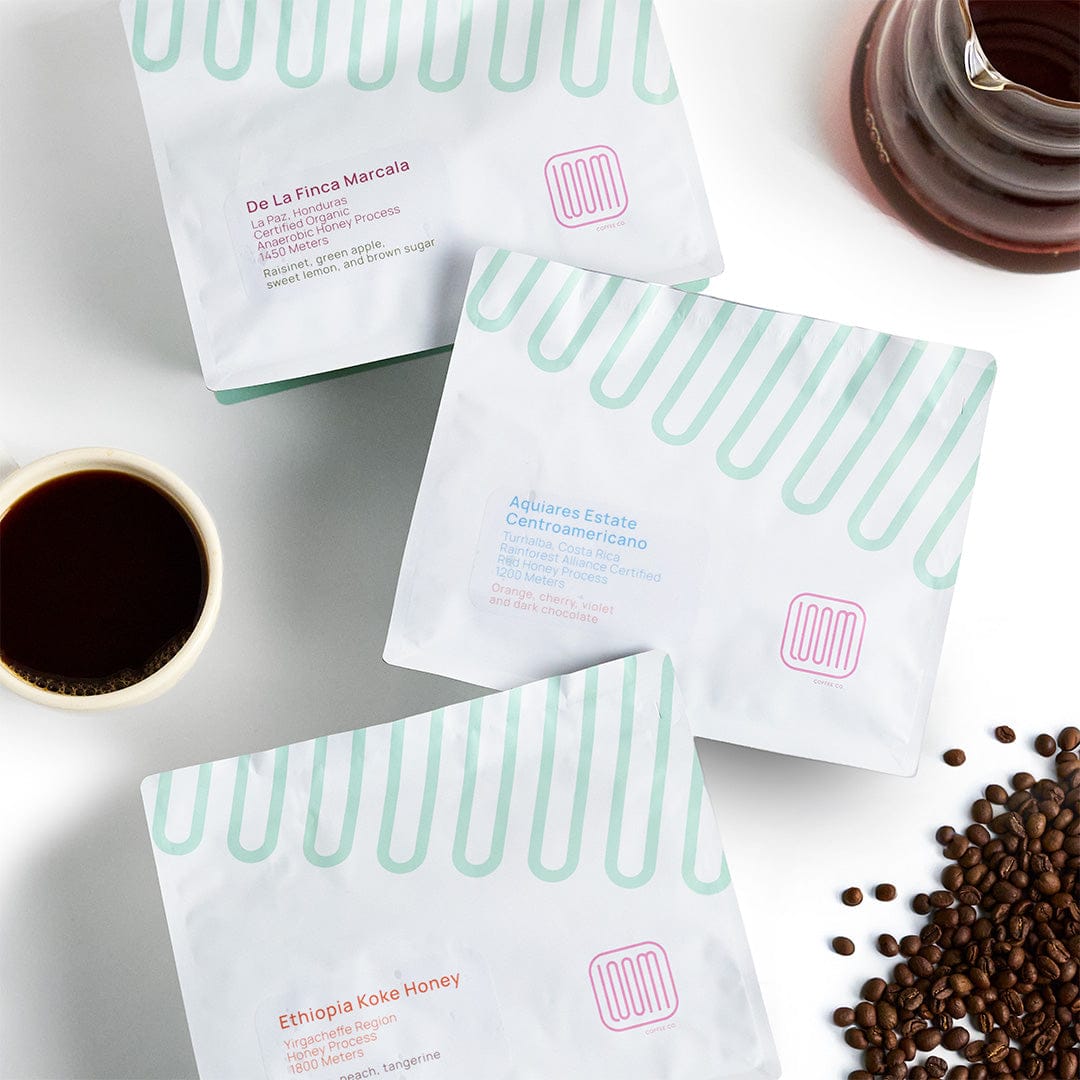

Try coffees like this one, on your schedule.
The Rotation is your coffee membership. Every order is a different single-origin, roasted to order and shipped within 48 hours. Explore our full lineup and find you next favorite.
You set the schedule, adjust or cancel anytime.
Natural processing dries the whole coffee cherry intact on raised beds, allowing the fruit to slowly dehydrate around the seed over 20 to 25 days. The extended fruit contact transfers sugars and fruity compounds into the seed, producing sweeter, more fruit-forward cups than washed processing. At 2,100 meters in the Guji Zone, the slow high-altitude drying and deep volcanic soil contribute to dense, complex flavor development.
Volcanic soil is rich in minerals like potassium, phosphorus, and nitrogen that feed coffee trees without heavy fertilization. The porous structure drains well, preventing waterlogging while retaining enough moisture for steady growth. The Guji Zone highlands sit on ancient volcanic terrain at 2,200 meters, where 220 hectares of semi-forest land produce coffee under wild canopy with the mineral density contributing to the chocolate foundation beneath the berry and tropical fruit character.
JARC stands for Jimma Agricultural Research Center, Ethiopia's primary coffee breeding institution. JARC varieties like 74112 and 74110 are hybrids developed for coffee berry disease resistance and strong yields while maintaining cup quality. They grow under wild canopy in the highlands here, where slow cherry development at 2,200 meters builds concentrated sweetness and layered fruit character.
Plot Duba at Megadu Farm sits at 2,200 meters in deep volcanic soil under wild canopy, with 850 workers managing 220 hectares of semi-forest land. The altitude slows cherry development, the volcanic minerals feed complexity, and the natural processing concentrates everything. The chocolate-covered strawberry, black currant, and pineapple character reflects all three factors converging.
Bette Buna, a Dutch-Ethiopian company founded in 2020, operates the farm in partnership with Chief Gash Duba and Ato Saffay. They farm 220 hectares of semi-forest land in the Guji Zone highlands of Oromia, Ethiopia, supporting 850 workers. The operation farms established highland plots where JARC 74112 and 74110 varieties grow under wild canopy.