Your Cart is Empty

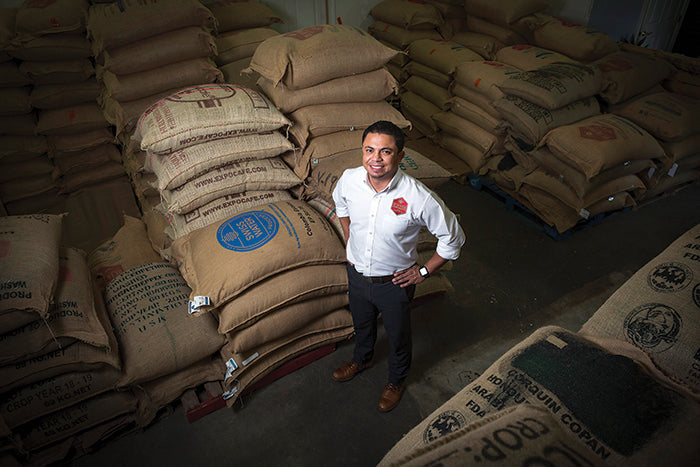

Finding A Home for Every Coffee with Nelson Amador
About Nelson Amador and De La Finca Coffee
Nelson Raul Amador was born into the world of coffee. He's a fifth-generation coffee farmer from Honduras and founder of De La Finca Coffee, a direct trade green coffee importer who brings Honduran coffees from farming families to roasters in the US. The Honduras coffees on our menu at Loom Coffee Co. represent years of Nelson and De La Finca's work connecting farmers, roasters, and coffee consumers directly. Nelson also works closely with Educate2Envision, a nonprofit building secondary schools in Honduras and providing youth scholarships in coffee-producing communities.
Alejandra Bedoya and Loom Coffee Co. co-founder Christopher Pierce sat down with Nelson for a wide-ranging conversation. If you've enjoyed any of our Education Coffees from Honduras, we hope this adds some depth to your experience of those coffees. Nelson also covers what it takes to build a direct trade importing business from the ground up.
Key takeaway: Nelson Amador, a fifth-generation Honduran coffee farmer, built De La Finca to connect farming families directly with roasters. The model is straightforward: full cost transparency, a portion of profits funding schools through Educate2Envision, and relationships that start at the farm.
Below is an abbreviated transcript of our conversation with Nelson. To hear the full interview, click below.
Nelson's Story: A Legacy of Honduras Coffee
From June 29, 2022 via Zoom:
Alejandra Bedoya: Before we begin, can you tell me a little bit about yourself, your background and family history in coffee farming?
Nelson Amador: I'm originally from Honduras and was actually born into the industry. I grew up in Honduras and always wanted to bring coffee to the United States. It was just an idea of, "How can I get connected with my culture, coffee, and family?" I had the opportunity to come to America and go to school, and that's how I saw that people appreciate coffee, but a lot of people don't know exactly where their coffee is coming from. I thought, "How can I tell the stories of these coffees? How can we send coffee from Honduras to the United States?"
It was a lot of planning which included many trips from the Honduras to the US, talking to roasters, and everything in between. As a farmer, I know a lot about producing, but I didn't know anything about exporting or importing. I knew a lot back home, but I didn't know anything about importing coffee or selling coffee. I asked myself, "How can I become that connection between a roaster and the producers?" That's why I decided to stay here in the United States and start a company that would be that connection between the roaster and the family that grows the coffee.

Nelson with his grandfather, Raul Rodriguez, a third-generation coffee farmer and owner of Finca Santa Lucia in Comayagua, Honduras.
Challenges and Misconceptions in Direct Trade Coffee
AB: What would you say are some common misconceptions about the green coffee trade?
NA: It depends on what's important for you as a buyer. As a producer, when you have a farm, you want to sell everything - including your most expensive, fancy coffees, your standard or averages, and sometimes your rejects. A trader comes to understand that. The job of a coffee trader is to identify where to allocate particular coffees with a roaster. We do this internally in Honduras with my family - they'll bring the coffee into the mill and we will evaluate the coffees by cupping them. If the coffee is not good, we will let them know if their coffee is not good for these roasters, however we may have a potential roaster who's interested. Trading coffee means I'm selling coffee, so in my case, I think of myself more as a consultant. People think that when we trade coffee, we're just selling coffee. In my line of work, it's more than that. We are more into a relationship and connecting with the people. I will find the group of people that benefits.
AB: Can you tell us about some of the challenges that you've faced in establishing a direct-trade, coffee-importing business?
NA: When you talk about direct trade, there's a lot of misconceptions. What do we know about direct-trade? Do we understand the process of working directly with the producer? When I started, I didn't know anything about that. I wanted to sell coffee to a roaster directly. Understanding the business was the most challenging part; I thought I would bring the samples, they would buy it now, and I would collect the payment. There's more to it, though. I had to figure out a way to send the coffee and how to finance it. All of this was the most challenging part. Then, I had to get people to trust me. How can we both help each other and how can we both trust each other?
I realized that being in Honduras was going to be very challenging with the financial aspect of everything. So, I decided to establish a business here (in the US) so that it would protect the producers and build relationships with the roasters here. We are building a team in the United States and I also have a team in Honduras. Each producer and each roaster has a different mentality; overcoming that aspect has taken me some years. Since this is legitimate direct-trade, I understand how much you want to buy and what type of coffee you are looking for, and I know what it's going to take as far as shipping and logistics. We break everything down and tell them how much it will cost and how much they will pay, and we connect all of that, making it simple and easier for everyone.
The Role of Roasters in the Global Coffee Trade
AB: What message would you give to roasters and coffee-industry workers in the United States about Honduras coffee, or about their role in the global coffee trade?
NA: Honduras coffee wasn't yet discovered ten years ago - Honduras coffee was only used for blended coffees. We have a rich soil, high mountains, and the climate is ideal to grow coffee. We have coffee that I've put on tables that taste completely different because they come from different regions. You can have good quality coffee, traceable sources, and really good prices. When I work with roasters, they not only support farmers in one community, but also create impact in different ways. When you buy direct-trade coffee, you're supporting communities because we encourage producers to do better work and pay higher wages to employees. We have also partnered with different nonprofits to help make changes in the community. You're supporting us and we'll do our part. Our part is to make sure that whatever you receive has a good quality, is traceable, and is sourced ethically.
Honduras coffee has a lot of potential and opportunities. We're also open to trying new things. In the past three years, De La Finca has invested a lot in in technology and has tried to come up with new flavor profiles. We also educate other producers in our area to do the same thing, to find other outlets for those coffees. We're also a very close country so we can get coffee faster than other origins.

Ripe coffee cherries harvested at Nelson Amador's Marcala Farm Project in La Paz, Honduras.
Educate2Envision: Reimagining Education in Rural Honduras
AB: Loom Coffee Co. was introduced to Educate2Envision through De La Finca. Can you tell us a little bit about your own connection with Educate2Envision?
NA: I was already working on an education project with De La Finca in Honduras, and we saw that Katia, the president (of E2E), was also doing some work with coffee. We told her, "Hey, coffee is what we do the best, and your thing is education - why don't we work together?"
We became a strong supporter of what they do, especially in that aspect of coffee communities. We bought a new farm last year, and we had a meeting to tell the community that we were coming to work - we just wanted to get to know the community. People told us that they kept asking the mayor to help them have a middle school here and it hadn't happened. I told them, "Let me talk to Katia and we'll see if we can make it happen." It took a month and a half for them to build a school there. In the first year, we've already gotten sponsors to do a building and to even create a technical school in that area.
AB: How have you personally seen the impact of Educate2Envision in a tangible way?
NA: We can immediately see the impact with the first school that we started three years ago. A lot of those kids now are graduating and some of them are even coming to work for us or looking for other opportunities. We saw an immense impact. Our next move is to create an advanced education program and we are already talking about that. How can we make them professionals? In the first location that we started where the kids have already graduated, a lot of them don't have the funding to move to the city to go to university. We are trying to create technical education there and partner with universities.
Last time I was there, I had meetings with students and they were continually thanking us for the educational opportunities. I told them that I wanted to see them be good professionals and also advised them when you see opportunities, give opportunities to others. I don't know where those kids will go in life, but when they become successful, I hope that they give back to whatever community they go to.
Educate2Envision Partnership
As part of our ongoing partnership with Educate2Envision, a nonprofit promoting education in rural Honduras, a portion of all profits from our Honduras coffees goes directly to E2E.
These funds build secondary schools in coffee-producing communities and provide youth scholarships.

The Future of De La Finca: Fostering Community and Connection
AB: What would you say are you most excited about in regards to DLF, farming, or coffee in general?
NA: To me, it's people. Coffee is what I love, I love to drink coffee, and everything that relates to coffee. But without making an impact on others' lives and creating jobs, it wouldn't have a point. It excites me to see what we do here in the United States. I have a team here and that's something I never imagined. I started this company by myself and I was the only employee for 3 years, and now I have a team that is growing while contributing to the community. That's what excites me the most, seeing the growth not in just economical, but also in jobs, people, and education.
That passion that I have to connect with my roasters is one of the reasons why I think people like to work with us. They see how excited we are about our work and our people. I think that's the most important thing for me that we do is the impact. I tell them, "We have a product that everybody loves, no matter where you go." Through that cup of coffee, you are connected with so many different cultures, backgrounds, and that's something that always keeps me excited. I always ask myself, "What can I do next?" Everyone in the industry shares the same passion. Coffee has given me an opportunity to create opportunities not just for myself, but others.
We're grateful to Nelson for his time and generosity in this conversation.
De La Finca Coffee is a direct trade green coffee importer founded by Nelson Amador, a fifth-generation Honduran coffee farmer. The company connects farming families in Honduras directly with roasters in the US through full cost transparency, breaking down exactly how much each step costs and how much producers receive. Nelson describes the role as closer to a consultant than a traditional trader, finding the right roaster match for each coffee a farm produces.
Direct trade with De La Finca means Nelson's team evaluates coffees at the mill in Honduras, matches each lot to a roaster based on quality and profile, then handles all shipping and logistics with full price breakdowns for both sides. It's a relationship-driven model where Nelson maintains teams in both Honduras and the US to protect producers and build trust with roasters. That structure took years to build, starting as a one-person operation.
A portion of all profits from Loom's Honduras coffees goes directly to Educate2Envision, a nonprofit that builds secondary schools in coffee-producing communities and funds youth scholarships. Nelson connected E2E with a community that had been asking their local government for a middle school; E2E built one in a month and a half. Graduates from E2E's first school, built three years ago, are now entering the workforce or pursuing further education.
De La Finca sources from multiple regions across Honduras, including Comayagua (home to Finca Santa Lucia, owned by Nelson's grandfather Raul Rodriguez) and La Paz (home to the Marcala Farm Project). Nelson emphasizes that Honduras coffees from different regions taste completely different from one another, and that the country's rich soil, high mountains, and favorable climate produce traceable, high-quality coffees at competitive prices.
Loom's Honduras coffees represent years of De La Finca's work building direct connections between farming families and roasters. The model aligns with how Loom sources: traceable, single-origin coffees with transparent supply chains. The partnership also funds education through Educate2Envision, meaning each purchase supports school construction and scholarships in the communities where the coffee is grown.