Your Cart is Empty

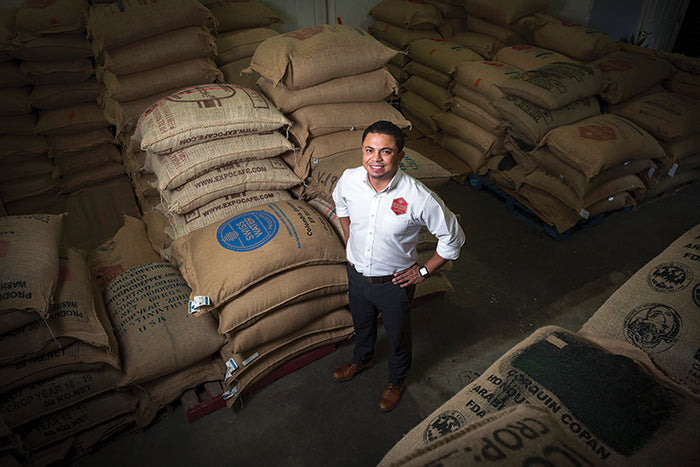

Finding a home for every coffee with Nelson Amador
About Nelson Amador and De La Finca Coffee
Nelson Raul Amador is a fifth-generation Honduran coffee farmer and the founder of De La Finca Coffee, a green coffee importer connecting Honduran farming families with US roasters. Our sourcing relationship includes Honduras coffees from those families. Nelson also works with Educate2Envision, a nonprofit building secondary schools in Honduras and providing youth scholarships in coffee-producing communities.
Alejandra Bedoya and Loom Coffee Co. co-founder Christopher Pierce spoke with Nelson on June 29, 2022. He describes financing, logistics, finding a buyer for different coffees, and his work with education projects. Our Education Coffees from Honduras provide context for that relationship, but the interview reflects the projects and plans he described in 2022.
Key takeaway: Nelson Amador explains how De La Finca connects producers with roasters, makes importing costs visible, and works with Educate2Envision in Honduran coffee communities.
Below is an abbreviated transcript of our conversation with Nelson. To hear the full interview, click below.
Nelson's background in Honduran coffee
From June 29, 2022 via Zoom:
Alejandra Bedoya: Before we begin, can you tell me a little bit about yourself, your background and family history in coffee farming?
Nelson Amador: I'm originally from Honduras and was actually born into the industry. I grew up in Honduras and always wanted to bring coffee to the United States. It was just an idea of, "How can I get connected with my culture, coffee, and family?" I had the opportunity to come to America and go to school, and that's how I saw that people appreciate coffee, but a lot of people don't know exactly where their coffee is coming from. I thought, "How can I tell the stories of these coffees? How can we send coffee from Honduras to the United States?"
It was a lot of planning which included many trips from the Honduras to the US, talking to roasters, and everything in between. As a farmer, I know a lot about producing, but I didn't know anything about exporting or importing. I knew a lot back home, but I didn't know anything about importing coffee or selling coffee. I asked myself, "How can I become that connection between a roaster and the producers?" That's why I decided to stay here in the United States and start a company that would be that connection between the roaster and the family that grows the coffee.

Nelson with his grandfather, Raul Rodriguez, a third-generation coffee farmer and owner of Finca Santa Lucia in Comayagua, Honduras.
Challenges and Misconceptions in Direct Trade Coffee
AB: What would you say are some common misconceptions about the green coffee trade?
NA: It depends on what's important for you as a buyer. As a producer, when you have a farm, you want to sell everything - including your most expensive, fancy coffees, your standard or averages, and sometimes your rejects. A trader comes to understand that. The job of a coffee trader is to identify where to allocate particular coffees with a roaster. We do this internally in Honduras with my family - they'll bring the coffee into the mill and we will evaluate the coffees by cupping them. If the coffee is not good, we will let them know if their coffee is not good for these roasters, however we may have a potential roaster who's interested. Trading coffee means I'm selling coffee, so in my case, I think of myself more as a consultant. People think that when we trade coffee, we're just selling coffee. In my line of work, it's more than that. We are more into a relationship and connecting with the people. I will find the group of people that benefits.
AB: Can you tell us about some of the challenges that you've faced in establishing a direct-trade, coffee-importing business?
NA: When you talk about direct trade, there's a lot of misconceptions. What do we know about direct-trade? Do we understand the process of working directly with the producer? When I started, I didn't know anything about that. I wanted to sell coffee to a roaster directly. Understanding the business was the most challenging part; I thought I would bring the samples, they would buy it now, and I would collect the payment. There's more to it, though. I had to figure out a way to send the coffee and how to finance it. All of this was the most challenging part. Then, I had to get people to trust me. How can we both help each other and how can we both trust each other?
I realized that being in Honduras was going to be very challenging with the financial aspect of everything. So, I decided to establish a business here (in the US) so that it would protect the producers and build relationships with the roasters here. We are building a team in the United States and I also have a team in Honduras. Each producer and each roaster has a different mentality; overcoming that aspect has taken me some years. Since this is legitimate direct-trade, I understand how much you want to buy and what type of coffee you are looking for, and I know what it's going to take as far as shipping and logistics. We break everything down and tell them how much it will cost and how much they will pay, and we connect all of that, making it simple and easier for everyone.
The Role of Roasters in the Global Coffee Trade
AB: What message would you give to roasters and coffee-industry workers in the United States about Honduras coffee, or about their role in the global coffee trade?
NA: Honduras coffee wasn't yet discovered ten years ago - Honduras coffee was only used for blended coffees. We have a rich soil, high mountains, and the climate is ideal to grow coffee. We have coffee that I've put on tables that taste completely different because they come from different regions. You can have good quality coffee, traceable sources, and really good prices. When I work with roasters, they not only support farmers in one community, but also create impact in different ways. When you buy direct-trade coffee, you're supporting communities because we encourage producers to do better work and pay higher wages to employees. We have also partnered with different nonprofits to help make changes in the community. You're supporting us and we'll do our part. Our part is to make sure that whatever you receive has a good quality, is traceable, and is sourced ethically.
Honduras coffee has a lot of potential and opportunities. We're also open to trying new things. In the past three years, De La Finca has invested a lot in in technology and has tried to come up with new flavor profiles. We also educate other producers in our area to do the same thing, to find other outlets for those coffees. We're also a very close country so we can get coffee faster than other origins.

Ripe coffee cherries harvested at Nelson Amador's Marcala Farm Project in La Paz, Honduras.
Educate2Envision: Reimagining Education in Rural Honduras
AB: Loom Coffee Co. was introduced to Educate2Envision through De La Finca. Can you tell us a little bit about your own connection with Educate2Envision?
NA: I was already working on an education project with De La Finca in Honduras, and we saw that Katia, the president (of E2E), was also doing some work with coffee. We told her, "Hey, coffee is what we do the best, and your thing is education - why don't we work together?"
We became a strong supporter of what they do, especially in that aspect of coffee communities. We bought a new farm last year, and we had a meeting to tell the community that we were coming to work - we just wanted to get to know the community. People told us that they kept asking the mayor to help them have a middle school here and it hadn't happened. I told them, "Let me talk to Katia and we'll see if we can make it happen." It took a month and a half for them to build a school there. In the first year, we've already gotten sponsors to do a building and to even create a technical school in that area.
AB: How have you personally seen the impact of Educate2Envision in a tangible way?
NA: We can immediately see the impact with the first school that we started three years ago. A lot of those kids now are graduating and some of them are even coming to work for us or looking for other opportunities. We saw an immense impact. Our next move is to create an advanced education program and we are already talking about that. How can we make them professionals? In the first location that we started where the kids have already graduated, a lot of them don't have the funding to move to the city to go to university. We are trying to create technical education there and partner with universities.
Last time I was there, I had meetings with students and they were continually thanking us for the educational opportunities. I told them that I wanted to see them be good professionals and also advised them when you see opportunities, give opportunities to others. I don't know where those kids will go in life, but when they become successful, I hope that they give back to whatever community they go to.
Education projects discussed in the interview
In the 2022 conversation, Nelson describes De La Finca's work with Educate2Envision in Honduran coffee communities.
He discusses school construction, scholarships, and plans for further technical education.

What Nelson wanted to build next
AB: What would you say are you most excited about in regards to DLF, farming, or coffee in general?
NA: To me, it's people. Coffee is what I love, I love to drink coffee, and everything that relates to coffee. But without making an impact on others' lives and creating jobs, it wouldn't have a point. It excites me to see what we do here in the United States. I have a team here and that's something I never imagined. I started this company by myself and I was the only employee for 3 years, and now I have a team that is growing while contributing to the community. That's what excites me the most, seeing the growth not in just economical, but also in jobs, people, and education.
That passion that I have to connect with my roasters is one of the reasons why I think people like to work with us. They see how excited we are about our work and our people. I think that's the most important thing for me that we do is the impact. I tell them, "We have a product that everybody loves, no matter where you go." Through that cup of coffee, you are connected with so many different cultures, backgrounds, and that's something that always keeps me excited. I always ask myself, "What can I do next?" Everyone in the industry shares the same passion. Coffee has given me an opportunity to create opportunities not just for myself, but others.
We're grateful to Nelson for his time and generosity in this conversation.
Source
Amador, Nelson. Interview by Alejandra Bedoya and Christopher Pierce. Zoom, 29 June 2022. Abbreviated transcript published by Loom Coffee Co.
De La Finca Coffee is a green coffee importer founded by Honduran producer Nelson Amador. In this June 2022 interview with Loom Coffee Co., he describes evaluating coffees, matching lots with roasters, and handling financing and logistics. He also explains how his team makes importing costs visible to buyers.
In the 2022 interview, Nelson Amador describes De La Finca's model as a relationship between producers, an importing team, and roasters. His team evaluates lots in Honduras and works through shipping, financing, and pricing. Direct trade is best understood through those specific arrangements; the phrase alone doesn't establish a universal payment or quality standard.
In the June 2022 interview, Nelson Amador describes De La Finca's work with Educate2Envision in Honduran coffee communities. He discusses a school project, scholarships, and plans for technical education. Those statements describe the projects at the time of the interview and don't establish a current donation rate for every coffee purchase.
The interview and captions include Finca Santa Lucia in Comayagua, owned by Nelson Amador's grandfather Raul Rodriguez, and the Marcala Farm Project in La Paz. They illustrate De La Finca's work across Honduran coffee communities. Current sourcing and lot availability need to be checked separately.
Loom Coffee Co.'s relationship with De La Finca connects our Honduran coffees with named farming families and the team handling their import. Nelson's interview explains that work in his own words. It also provides historical context for education projects discussed in the conversation.