Your Cart is Empty

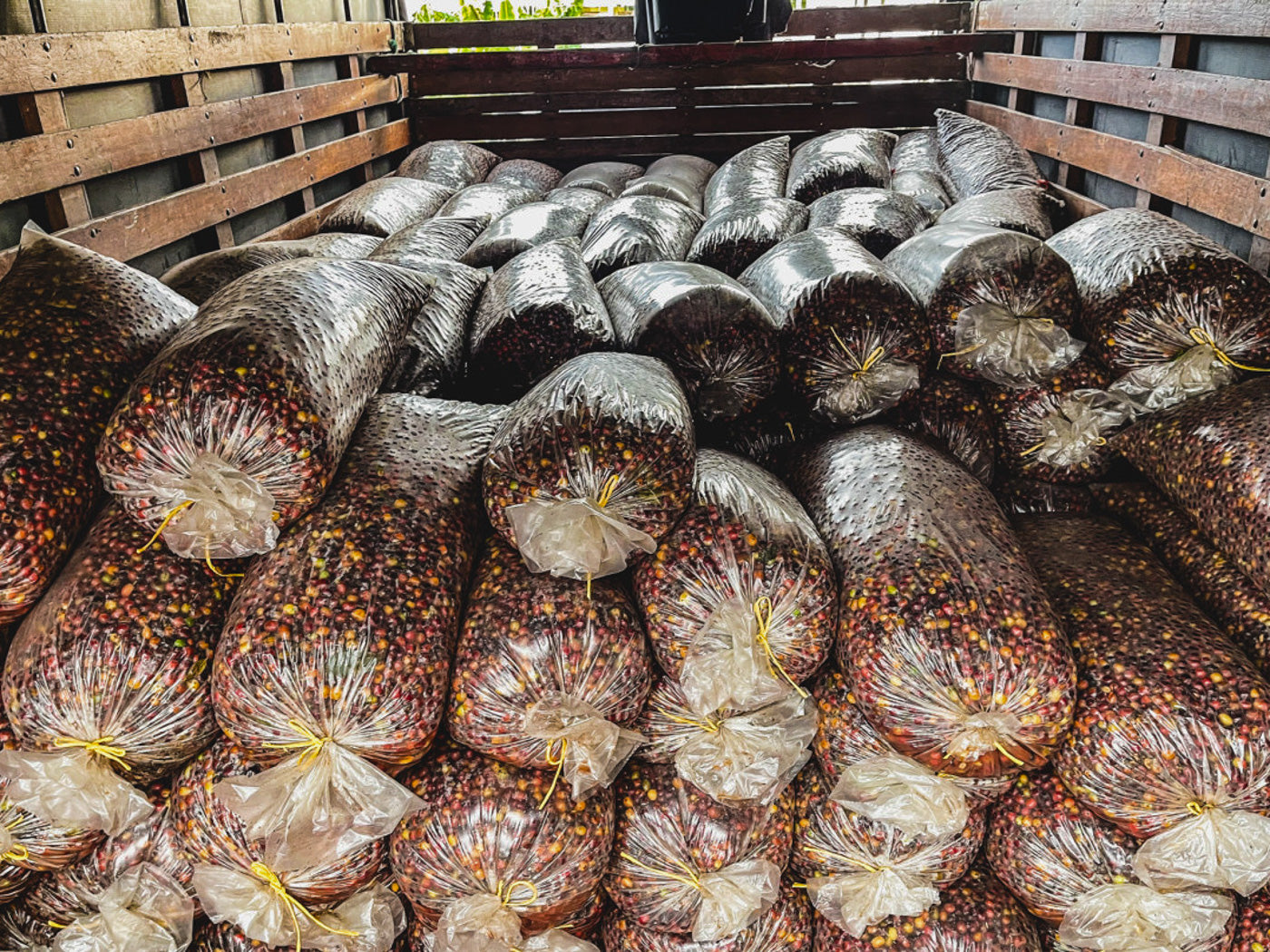

What does "anaerobic" actually mean on your coffee bag?
The word "anaerobic" shows up on more coffee bags every year. It's become shorthand for "funky," "fruity," "experimental," or just "expensive." Anaerobic describes an environment: a sealed container that controls which microorganisms get to work on your coffee. Variety, growing conditions, and fermentation parameters determine what you actually taste. The sealed container is one variable among many. The gap between what that label communicates and what's actually happening to your coffee is worth understanding.
What does anaerobic actually mean on a coffee label?
Anaerobic means "without oxygen." That's it. When a producer labels coffee as anaerobically fermented, they're telling you the fermentation happened in a sealed container rather than an open-air tank. Sealed tanks, sealed bags, sealed barrels. The container keeps oxygen out, and that single variable changes which microorganisms drive the fermentation.
Fermentation is biochemically anaerobic by definition. Yeast and bacteria break down sugars through electron transfer, and that process doesn't use oxygen regardless of whether the tank is sealed or open. The term "anaerobic fermentation" is redundant. As fermentation scientist Lucia Solis argues, the distinction that actually matters is between sealed and open environments, because that determines which microbial populations dominate (Solis, "Are All Coffees That Are Not Anaerobic, Aerobic?").
Calling it "anaerobic" is like describing coffee fermented in a "blue tank." Solis goes further, arguing producers would be better off dropping pseudo-scientific terminology in favor of proprietary "fantasy names" for their processes. Names like "Nirvana" or "Galaxy Process" at least don't claim a uniformity that doesn't exist (Solis, "Are All Coffees That Are Not Anaerobic, Aerobic?").
Key takeaway: "Anaerobic" on a coffee label tells you the fermentation happened in a sealed container. It doesn't tell you which microbes did the work, for how long, or at what temperature. Those details shape your cup far more than the word on the bag.
Traditional washed processing ferments coffee in open cement tanks. Oxygen is present. The microbes that thrive in those conditions (aerobic bacteria, certain yeasts, eventually filamentous fungi) do the work of breaking down the sticky mucilage layer surrounding the coffee seed, dissolving the mucilage structure either through enzymatic action or by using it as a carbon source (Folmer).
Seal that same tank, and you've changed the environment. Oxygen-dependent organisms can't survive. New bacteria take over. Yeasts that couldn't compete in open air now dominate. These organisms produce different metabolic byproducts than their aerobic counterparts as they break down mucilage through different enzymatic and metabolic mechanisms (Folmer). The principle is the same one behind sourdough starters, wine fermentation, and kimchi. Control the environment, and you control which microbes do the work.
The label doesn't specify which microbes, doing what work, for how long, at what temperature.

What happens during anaerobic coffee fermentation?
The microorganisms that dominate without oxygen produce different organic acids than the ones that thrive with it, and those acids become the flavor precursors you taste after roasting. Microbial populations shift during fermentation; bacteria dominate early, followed by different yeast species, then filamentous fungi as conditions become more aerobic (Folmer). In sealed environments, lactic acid bacteria like Leuconostoc and Lactobacillus flourish. They produce lactic acid, which tends toward smooth, creamy mouthfeel in the cup. Acetic acid, produced in smaller quantities, adds brightness (or vinegar-like sharpness when fermentation runs too long). The specific balance of these acids depends on conditions the producer controls.
Temperature and duration are the variables that matter most.
Low and slow
Sealed tank held at 18°C for 72 hours. Lower temperatures slow fermentation and extend the window for lactic acid producers. The cup leans toward smooth, creamy mouthfeel with more fermentation-driven complexity.
Warm and fast
Same cherry fermented at 24°C for 48 hours. Higher temperatures accelerate fermentation and shift which microbial populations dominate and which acids accumulate (Solis). A different acid profile. A different cup entirely.
Same sealed tank. Same "anaerobic" label. Two completely different cups. As Hoffmann notes, "the hotter it is, the faster this process will occur" (Hoffmann).
These acids don't disappear after fermentation. Some are transformed during roasting into new volatile compounds. Others survive roasting unchanged and persist into the brewed cup (Solis and Algrano). The connection between fermentation and what you taste is more direct than the industry long assumed, and research into microbial precursors is still catching up.
The word on the bag captures a fraction of that chain.
If anaerobic isn't the flavor, what is?
Here's a useful test case. Our Blueberry Jelly Maracaturra sits deep in blueberry territory with a syrupy body. On our cupping table, we get ripe blueberries, rose water, graham cracker. The kind of cup most people would attribute to experimental processing.
The blueberry starts with the variety's genetics, but genetics alone don't guarantee it.
Maracaturra is a hybrid between Maragogype and Caturra. Hoffmann identifies Maragogype as a Typica mutation first discovered in Brazil, known for its unusually large seeds and sometimes called "Elephant coffee" (Hoffmann). Gold Mountain Coffee Growers, the farmer-owned cooperative that produces this lot, notes that the variety "tastes like blueberries even as a washed". They grow Maracaturra saplings on their flagship farm, Finca Idealista, in the Matagalpa highlands, specifically to gift to member farmers across Jinotega and Matagalpa. The genetic potential is there. Whether it shows up in the cup depends on terroir, ripeness at harvest, processing, and roast profile.

That's why variety, growing conditions, and processing interact rather than operate independently. Solis ranks the levers that shape cup quality in order of impact: origin characteristics first (variety, soil, growing practices), then roasting, then brewing, with processing last among them when done competently (Solis, "Beginners Guide to Coffee Processing"). The Maracaturra's genetic makeup provides the biochemical precursors for blueberry-forward esters. Sucrose content in coffee varies between 3% and 8% depending on variety (Solis and Algrano). The sweetness you taste starts with genetics, but it takes care at every step to preserve it.
GMCG's ripeness teams are part of that chain. Cherry selection at peak ripeness sets the starting material, and processing decisions shape which precursors survive and in what concentration.
The first processing decision carries more weight than it gets credit for: removing the pulp sends a germination signal to the seed, activating enzymes that break down carbohydrates and strengthen cell walls. A washed coffee and a natural from the same lot start different metabolic pathways before fermentation even begins (Solis, "Beginners Guide to Coffee Processing"). This lot's 16.5-hour fermentation encourages the breakdown of mucilage sugars and supports sweetness without distorting what the genetics, terroir, and harvest care already established. A 72-hour fermentation would layer in different acid compounds and risk overriding those origin characteristics.
Drying is another variable most people skip right past. The 12 days on raised drying beds at 1,200-1,500 meters aren't just logistics. Drying protocols pre-program how coffee behaves in the roaster: moisture targets, temperature control, and staging all affect solubility and flavor development in the final cup (Solis and Aysen).
Roasting is the final variable, and it's where every upstream decision either pays off or gets lost. Naturals roast differently than washed coffees because of different physical properties from drying; pulp naturals roast slower and don't reach the same solubility (Solis and Aysen). Citric and malic acids present in green coffee are "in part decomposed" as roast temperature climbs, yielding new compounds like succinic and fumaric acid (Jansen). A lighter profile preserves more of the origin character and acidity; the blueberry stays bright, the rose water stays delicate. Push darker and you trade those for body and caramelization. A different version of the same coffee.
850
Approximately 850 volatile aromatic compounds have been identified in roasted coffee, "most of [which] are formed by the Maillard reaction," alongside pyrolysis, hydrolysis, and oxidation (Jansen).
The volatile compounds you smell when you grind, the ones that fill the kitchen before you've even started brewing, are among them. They're the end product of every decision that came before: what was planted, where it grew, how it was picked, how long it fermented, and how our roasting team chose to develop it.
Why does any of this matter for your morning cup?
Understanding how these variables interact makes you better at finding coffee you'll enjoy and knowing why you enjoy it. That's the practical payoff.
Start with variety. A Maracaturra and a Caturra grown at the same elevation, processed the same way, produce different cups. The genetics gave them different starting materials. Once you notice that, the variety name on a bag stops being trivia and starts being information.
Fermentation duration and temperature shape the acid profile in ways you can learn to anticipate. A "72-hour anaerobic" coffee will likely have more lactic acid character (smooth, creamy) and more fermentation-driven complexity than a 16-hour washed lot from the same farm. Whether you prefer that is personal. But now you're choosing based on understanding.
Cherry ripeness is one of the most underrated variables in the chain. The difference between a producer who employs ripeness monitoring teams and one who bulk-harvests connects directly to your experience of sweetness in the cup. GMCG's teams wear bracelets the color of ripe cherries and sleep on member farms during picking. That intentionality shows up as consistency and sweetness concentration in what you're drinking.
Roast style is the final filter. The same green coffee roasted by two different people can taste like two different coffees. The green coffee carries potential. The roast decides which potential you meet.

The industry is starting to formalize this distinction. The SCA's new Coffee Value Assessment separates what a coffee tastes like (descriptive assessment) from how it was made (extrinsic assessment). Processing information, including fermentation method, duration, and temperature, lives in the extrinsic evaluation. It tells you about the producer's decisions and the coffee's story. What's in the cup lives in the descriptive assessment (SCA, "A System to Assess Coffee Value"). That separation is the institutional version of what we're describing here: "anaerobic" is information about how the coffee was processed.
This makes your morning routine richer. When you know that the blueberry in your Maracaturra starts with a hybrid variety's genetic potential, carried through by careful harvesting, preserved through a short fermentation window, dried on raised beds for 12 days at 1,200 meters, and roasted to keep those bright compounds intact, the cup you're holding carries a chain of decisions that started with a sapling on a mountaintop farm in Matagalpa.
The ritual is the same. The kettle heats, the water pours, the kitchen fills with that smell. But what you're tasting has a story you can actually follow now, and following it is part of what makes the whole thing worth slowing down for.
Sealed-environment fermentation is a real technique with real effects on your cup. The words on the bag are one variable among many: variety, growing conditions, fermentation parameters, drying protocol, and roast development all contribute.
Works Cited
Folmer, Britta. The Craft and Science of Coffee. Academic Press, 2017.
Hoffmann, James. The World Atlas of Coffee. 2nd ed., Mitchell Beazley, 2018.
Jansen, Gerhard. Coffee Roasting: Magic, Art, Science. 2006.
SCA. "A System to Assess Coffee Value." Specialty Coffee Association, June 2024.
Solis, Lucia. "Are All Coffees That Are Not Anaerobic, Aerobic?" Making Coffee, FTC Community, 2024. https://www.youtube.com/watch?v=P68iBPqsy5g
Solis, Lucia. "Beginners Guide to Coffee Processing." Making Coffee, FTC Community, 2024. https://open.spotify.com/episode/259CXOLAxQnQ9eEf0ghPxv
Solis, Lucia, and Algrano. "Fermentation Talk: Infusion Confusion." Making Coffee, FTC Community, 2024. https://www.youtube.com/watch?v=OY_ZuJ_jAUM
Solis, Lucia, and Aysen. "Designing Green Coffees for Roasting, Part 2." Making Coffee, FTC Community, 2024. https://www.youtube.com/watch?v=BmGfCnBm_l8
This is the first piece in a series on what actually happens to your coffee before you brew it. Next: how natural, washed, and honey processing work, what each method does to the cup, and how to use processing information to predict what you'll taste. Join our email list below to get each new piece when it publishes.
It means the coffee was fermented in a sealed container that kept oxygen out. That single environmental change determines which microorganisms drive the fermentation. The word tells you about the container, not about the specific flavor, duration, temperature, or microbial activity that shaped the cup.
Sealed-environment fermentation is a technique, not a quality grade. It produces different organic acids than open-air fermentation, which can create distinctive flavor profiles. Whether you prefer those profiles is personal. Variety, growing conditions, harvest care, and roast development all contribute as much or more to what you taste.
Temperature and duration during fermentation change which microbial populations dominate and which acids accumulate. The same cherry fermented at 18 degrees Celsius for 72 hours produces a fundamentally different cup than one fermented at 24 degrees for 48 hours. Same sealed tank, same label, two different results.
Fermentation doesn't add flavors directly. Microorganisms break down sugars in the coffee mucilage and produce organic acids like lactic and acetic acid. Those acids become flavor precursors that survive into the roasted coffee. What you taste is the combined result of fermentation chemistry, roasting decisions, and brewing variables.
Variety and genetics provide the biochemical starting material. Growing conditions, elevation, and harvest ripeness shape what's available. Processing and fermentation determine which compounds survive and in what concentration. Roasting transforms those precursors into the volatile compounds you smell and taste. Each step in that chain carries more weight than any single label on the bag.
Lower temperatures slow fermentation and extend the window for lactic acid producers, which tend toward smooth, creamy mouthfeel. Higher temperatures accelerate the process and shift which microbial populations dominate, changing the acid profile entirely. A few degrees of difference can produce a noticeably different cup from the same starting cherry.